

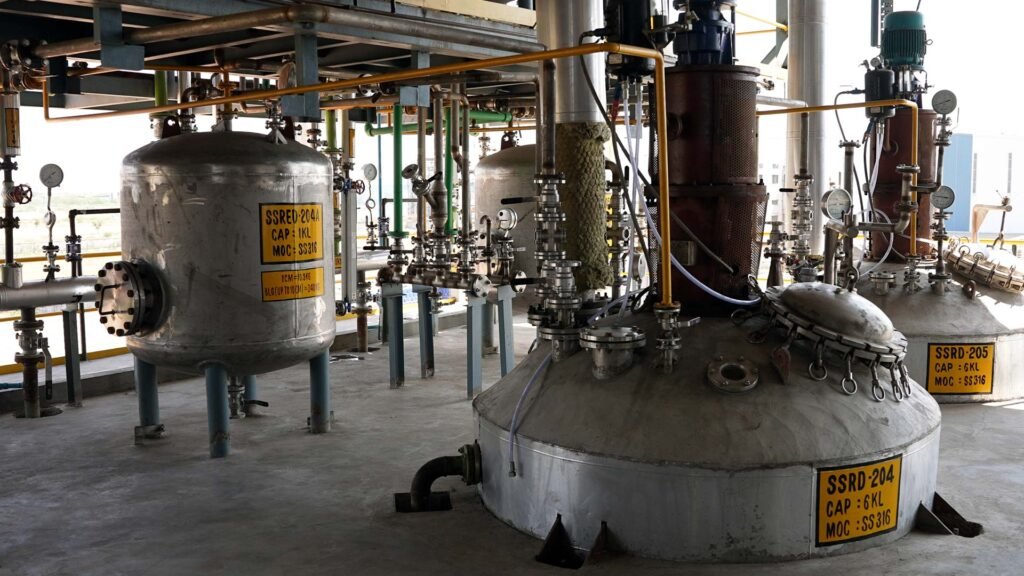
A reaction that performs reliably in a 500 mL flask will not automatically behave the same way in a 5,000 L reactor. During chemical process scale-up, surface-area-to-volume ratios, mixing times, heat-transfer rates and material-handling steps all change. The chemistry may be unchanged on paper, but the physical system is not.
Successful scale-up therefore requires an engineering review of the full batch, not simply multiplying each laboratory quantity by the same factor.
1. Heat transfer
Small flasks heat and cool quickly. Large vessels store far more thermal energy, while the available heat-transfer area does not increase at the same rate as volume. An addition that appears mild in the lab can create a rapid temperature rise at plant scale.
Review reaction calorimetry where appropriate, expected heat release, cooling capacity, dosing time, emergency quench strategy and the consequences of utility failure. For endothermic stages, confirm that the plant can reach and maintain the required temperature without extending cycle time unexpectedly.
2. Mixing and mass transfer
Magnetic stirring can create near-instant mixing in a flask. A large reactor may develop concentration or temperature gradients, particularly with viscous phases, gas-liquid reactions, slurries or immiscible liquids. Agitator type, speed, baffles, fill volume and addition point all matter.
Poor mixing can cause local over-concentration, side reactions, delayed neutralisation or inconsistent crystallisation. Scale-up plans should define what must remain comparable—such as mixing time, power per unit volume or mass-transfer performance—rather than copying laboratory rpm.
3. Impurity accumulation
Trace impurities can become visible when raw-material lots, recycled solvents and multiple process stages are combined at scale. Establish impurity fate early: does an impurity react, remain in the mother liquor, concentrate during solvent recovery or carry into the isolated product?
In-process testing at meaningful transition points can identify drift before the final release test.
4. Isolation and drying
Laboratory filtration may take minutes; a plant filtration and drying cycle can take hours. Cake depth, particle-size distribution, wash displacement, centrifuge or ANFD capacity, vacuum level and product sensitivity influence both yield and quality.
Define the endpoint with a suitable method. Water content, loss on drying and residual-solvent analysis answer different questions and should not be substituted without scientific justification.
5. Solvent handling
At plant scale, every solvent must be received, stored, charged, recovered and routed for reuse or treatment. Tank availability and segregation can affect the campaign schedule. Recovery quality can also influence subsequent batches, so acceptance criteria and batch-level balances should be agreed during transfer.
Build evidence before the commercial campaign
A sound transfer package defines critical process parameters, critical quality attributes, sampling points, acceptable hold times and clear escalation rules. A HAZOP or equivalent process-safety review should reflect the actual plant configuration. Deviations during the first batches should feed into documented corrective actions and controlled process updates.
Suntrox Finechem’s Dahej site includes glass-lined and SS316L reactors, filtration and drying equipment, solvent-recovery systems and in-house QC support for multipurpose campaigns. Explore our reaction capabilities and manufacturing facility, or contact us to review a scale-up project.