

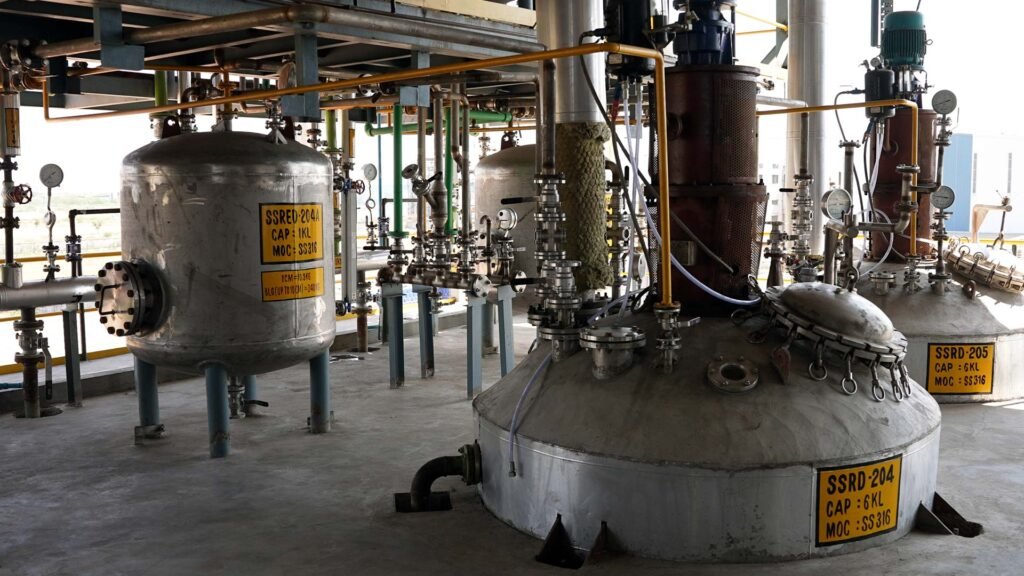
Bromination may look straightforward in a reaction scheme, but bromination at scale places demanding requirements on containment, heat removal, materials of construction and process control. Elemental bromine is volatile, dense and corrosive, while many brominations release heat quickly and generate hydrogen bromide.
The following five challenges should be addressed before a process moves into a plant campaign.
1. Handling elemental bromine
Bromine fumes readily at ordinary plant temperatures and requires contained storage and transfer. Equipment compatibility must be assessed across the full path from the storage or day vessel to the reactor. Dosing accuracy is also important because small excesses can affect selectivity and downstream neutralisation load.
Closed transfer, suitable ventilation, emergency containment and task-specific personal protection should be supported by trained operators and clear response procedures.
2. Managing a fast exotherm
Bromine addition can release heat faster than a large reactor removes it. The process review should define expected heat release, accumulation potential, cooling capacity and maximum safe dosing rate. Temperature-based interlocks and a response to loss of cooling or agitation should be established before charging.
Scale-up must account for the fact that heat-transfer area does not grow in direct proportion to batch volume.
3. Containing hydrogen bromide
Many substitution reactions generate hydrogen bromide as a by-product. The reactor vent, condenser and scrubber system must be designed for the expected gas load and credible upset conditions. Scrubber chemistry, circulation, temperature and monitoring need defined operating ranges.
Gas generation may continue during a hold, quench or warm-up, so the review cannot stop at the bromine-addition stage.
4. Protecting reaction selectivity
Mono- versus poly-bromination and regioselectivity can be sensitive to temperature, mixing, dosing profile, concentration and reaction time. Local excess bromine caused by poor mixing can create by-products even when the overall charge is correct.
A practical in-process method should track starting material, desired product and key over-brominated impurities. The sampling and analytical turnaround must be fast enough to guide the batch.
5. Managing bromide-containing streams
Scrubber liquor, aqueous work-up streams and residues may contain bromide or reactive bromine species. Segregation, neutralisation, testing and the approved treatment route should be defined during process transfer. Materials used in downstream tanks and lines must also be reviewed for corrosion.
A plant-ready bromination package
Before commercial execution, the package should cover reaction calorimetry where appropriate, equipment compatibility, dosing logic, critical parameters, sampling, scrubber capacity, emergency actions, quench strategy and waste routing. These decisions should be reflected in the batch record and HAZOP actions.
Suntrox Finechem evaluates bromination projects within its wider custom reaction capabilities and multipurpose manufacturing infrastructure. To discuss chemistry, scale and confidentiality requirements, contact our technical team.