

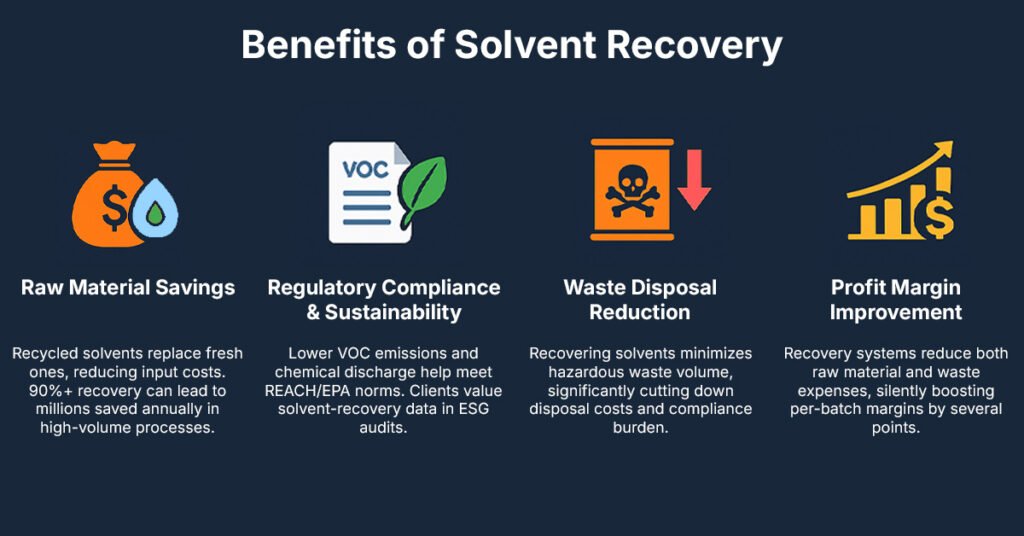
In specialty chemical manufacturing, solvent is not merely a processing aid. It can be one of the largest variable costs in a batch. The way a manufacturer stores, transfers, recovers and reuses solvent therefore affects cost per kilogram, waste generation, worker exposure and the consistency of the process itself.
Effective solvent recovery in chemical manufacturing is more than collecting condensate after a batch. It is a controlled system built around suitable equipment, defined purity limits and batch-level records.
Why solvent recovery matters
A process may use solvent during reaction, extraction, washing, crystallisation or equipment cleaning. Discarding every stream increases fresh-solvent purchases and the volume of material sent for treatment. Recovering a suitable stream can reduce both pressures, provided the recovered solvent meets the requirements of its intended reuse.
The commercial effect should be evaluated across the complete process. A high recovery percentage is not valuable if the recovered material introduces water, colour or trace impurities into the next batch. Recovery decisions therefore belong in the process and quality plan, not only in the waste-management plan.
What a robust recovery system includes
1. Distillation suited to the solvent system
Atmospheric distillation is not appropriate for every stream. High-boiling or heat-sensitive mixtures may need vacuum operation to lower the boiling temperature. Corrosive systems require compatible materials of construction in the column, condenser, receivers and transfer lines.
2. Closed handling and controlled storage
Closed transfers limit evaporative loss and reduce exposure. Clearly identified tanks and receivers help prevent mixing between recovered solvents of different grades. Storage capacity must also match campaign size; otherwise, recovered material can become a scheduling constraint instead of a saving.
3. Defined quality specifications
Recovered solvent should be tested against parameters relevant to the process. Depending on the chemistry, these may include water content, assay, density, colour, acidity or alkalinity, and specified residual impurities. The correct analytical method matters: water-specific testing such as Karl Fischer may be necessary when a general loss-on-drying result cannot distinguish water from other volatiles.
4. Recovery measured by batch
Campaign averages can conceal losses. A batch-level balance records solvent charged, recovered, accepted for reuse, rejected and sent for treatment. This makes abnormal losses visible and gives process teams a reliable basis for improvement.
Questions to ask a manufacturing partner
- Which solvent streams are segregated and recovered?
- Is vacuum distillation available where the boiling range or thermal stability requires it?
- How is recovered-solvent quality approved before reuse?
- Are recovery yields and losses recorded for every batch?
- How are corrosive vapours, emissions and residues contained?
- Does the storage system have enough capacity for the proposed campaign?
Solvent recovery at Suntrox Finechem
At Suntrox Finechem’s Dahej facility, solvent handling is supported by SS316L distillation columns with high-vacuum capability, graphite condensers for suitable corrosive services, closed-transfer systems and a CCOE/PESO-compliant underground solvent tank farm with more than 100 KL of capacity. Recovery is considered alongside process feasibility, quality requirements and campaign economics.
Explore our multipurpose manufacturing facility and our approach to environment, health and safety. To discuss a solvent-intensive process or campaign, contact the Suntrox team.