
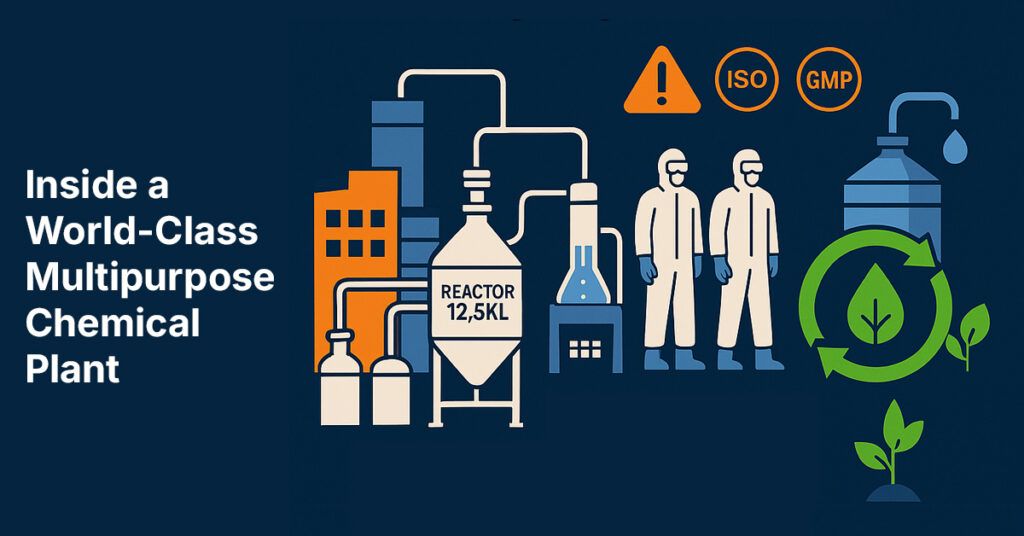
Top-tier multipurpose chemical plants share several infrastructure and compliance hallmarks. They are designed for flexibility: a typical facility will have a wide range of reactor sizes, distillation columns, filtration units and dryers that can be reconfigured for different chemistries. For instance, AGC Pharma Chemicals describes its multipurpose API plant as “designed for flexibility and scalability, enabling efficient production and offering a broad technology portfolio”. In practice this means one building can handle small R&D batches, pilot-scale runs and full commercial lots by swapping reactors and adjusting flow paths on demand.
Safety and containment are also key. World-class plants often include clean-room areas, ATEX-rated zones for flammables, and closed transfer systems. AGC’s facilities feature ISO-8 cleanrooms and OEB4/5 containment for potent compounds, along with dedicated airlocks and mist showers to prevent contamination. Such features enable processing of highly hazardous or high-potency chemicals without incident. Additionally, multipurpose plants usually implement solvent and waste recovery systems. Advanced distillation or evaporation units are integrated to recycle solvents (see below), and effluent treatment units or catalysts minimize waste.
Stringent quality systems underlie these capabilities. Leading contract manufacturers are routinely certified to ISO 9001 (quality), ISO 14001 (environment) and ISO 45001 (health/safety) standards. This integrated management system ensures every step from raw material intake to final QC testing is controlled. For example, ISO 9001 certification signals that the company maintains rigorous documentation, regular audits, and continual improvement processes. Plants may also follow industry-specific standards like GMP (for pharmaceutical intermediates) or IPC (for battery chemicals). Frequent customer audits and third-party inspections are the norm, ensuring reproducible quality.
In summary, world-class multipurpose plants combine: advanced, adaptable equipment + robust safety/containment features + comprehensive quality/environmental systems. These together deliver the reliable, high-quality production that specialty chemical clients demand.
Flexible Infrastructure
Multiple reactors (from liters to multi-m³), automated filtration and drying units, and modular piping all allow one plant to run many different chemistries. AGC notes its unit has an “OEB5 HPAPI bay with reactors volumes of 1.5 m³” alongside smaller kL labs, illustrating this.
Quality Management Systems
International certifications (ISO 9001, 14001, 45001) are now standard. According to industry experts, ISO 9001 “provides valuable assurance of a manufacturer’s commitment to quality management”, while ISO 14001 and ISO 45001 show dedication to environmental and safety. These systems ensure traceability, continuous training, and consistent output across batches.
Safety & Compliance
Top plants use explosion-proof controls, inert gas blanketing, gas detectors and containment isolators to handle dangerous chemistries safely. For example, AGC’s kilolab features 100% HEPA-filtered air and separate airlocks for materials and personnel, fully complying with stringent safety. Such measures minimize incident risks.
Sustainability Features
High-end plants integrate processes like solvent recovery (see below), energy-efficient distillation (multi-effect or vapor recompression), and waste recycling. Many have achieved industry accolades for environmental performance. By designing for reuse and low emissions, these facilities not only save costs but also help clients meet regulatory and ESG goals.