

Karl Fischer vs loss on drying is not a comparison between two interchangeable moisture tests. The methods respond to different components of a sample. Selecting the wrong one can hide retained solvent, overstate water content or create disagreement between a manufacturer’s certificate and a customer’s incoming test.
What loss on drying measures
Loss on drying (LOD) measures the reduction in sample mass after heating under specified conditions. That mass loss may include water, residual process solvents and other volatile components. The result depends on the test temperature, time, pressure and sample preparation.
LOD can be useful when the specification is intentionally concerned with total volatile matter. It does not, by itself, identify which volatile component was lost.
What Karl Fischer measures
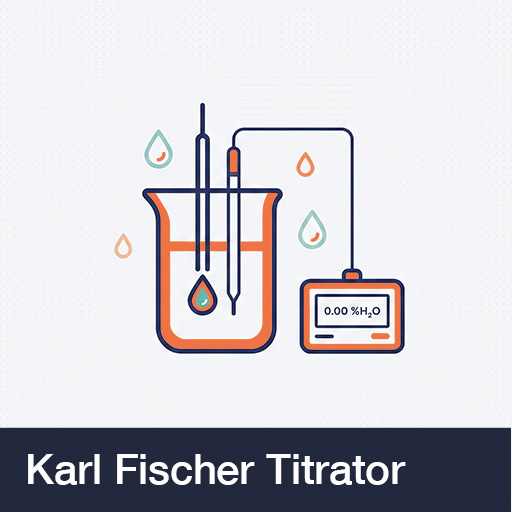
Karl Fischer titration is designed to determine water through a specific chemical reaction. Depending on the product, the laboratory may use volumetric or coulometric equipment and an appropriate sample-dissolution or oven-transfer method.
The method is particularly useful when water must be distinguished from organic solvents. However, method suitability still matters: solubility, side reactions, bound water and sample handling can affect the result.
Why the results can differ
Consider a wet cake that retains methanol. An LOD result can include both methanol and water, while Karl Fischer is intended to report water. Conversely, a hygroscopic product can gain water during sampling or transfer, causing a Karl Fischer result to rise even if the production drying endpoint was satisfactory.
Bound or slowly released water can also require a method designed to extract the water reproducibly. This is why a specification should name the method and conditions, not only state “moisture.”
When to specify each method
Consider Karl Fischer when:
- The limit is specifically for water.
- The product or process has a history of water sensitivity.
- Residual organic solvent may be present and must not be reported as water.
- The customer’s release method already uses Karl Fischer.
Consider loss on drying when:
- Total volatile content is the relevant quality attribute.
- The compendial or agreed specification defines the LOD conditions.
- The method has been shown to be suitable for the product and intended decision.
Some products require both results, with a separate residual-solvent method where process solvents are critical.
Avoid method mismatch during technology transfer
The quality agreement should identify the test method, instrument or technique, sampling procedure, sample-storage conditions, acceptance criteria and approach to atypical results. If the manufacturer and customer use different methods, establish comparability before commercial release rather than after a shipment is tested.
At Suntrox Finechem, in-process and release testing are managed through documented quality systems and an in-house laboratory. Learn more about our quality-assurance approach and analytical and manufacturing infrastructure. For a product-specific analytical discussion, contact our team.